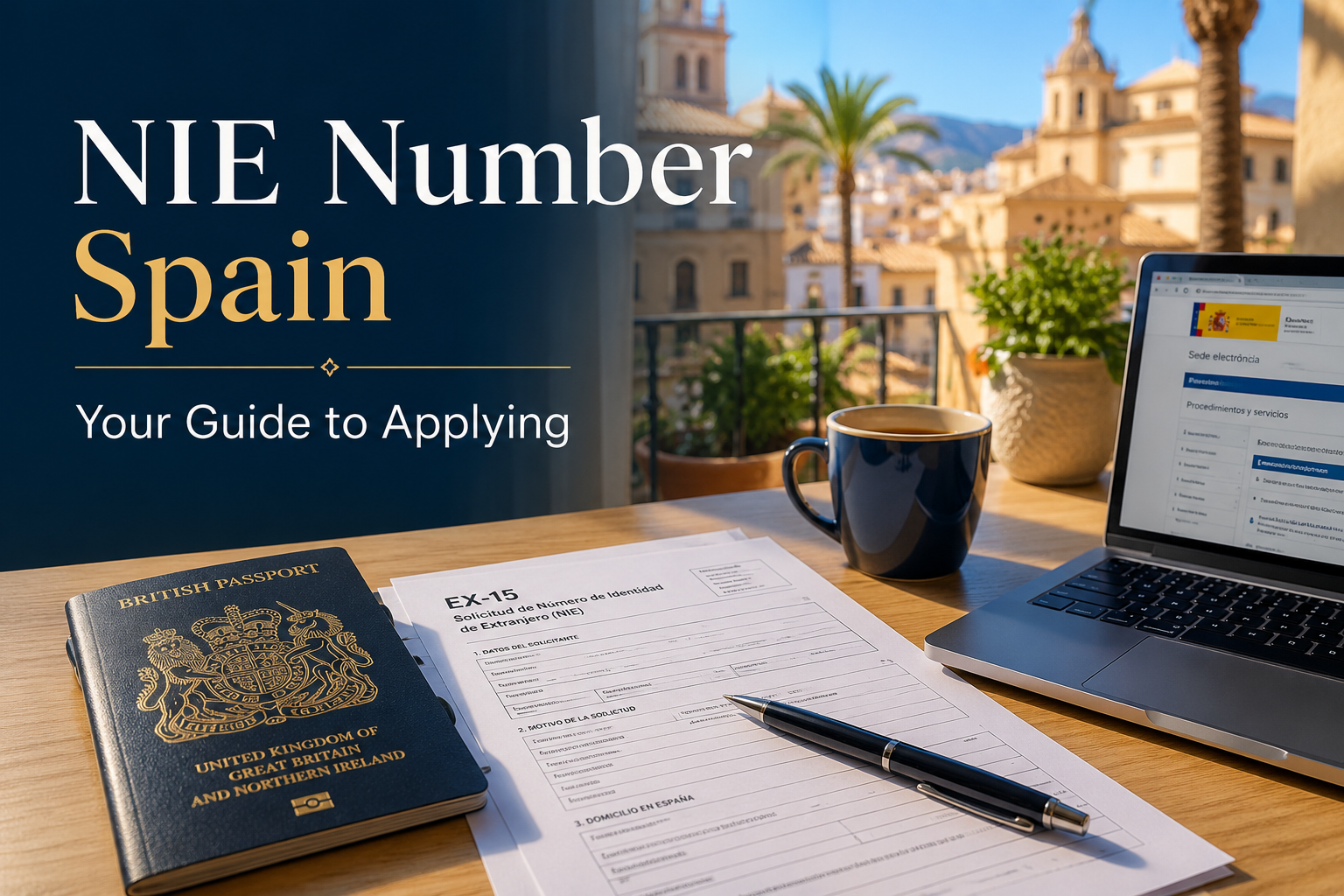
Planning to move to Spain, buy property, open a Spanish bank account or deal with Spanish authorities? An NIE number is likely to be one of the first things you will need.
The NIE (Número de Identidad de Extranjero) is the Spanish Foreigner Identity Number. It is a unique identification number assigned to foreign nationals who have economic, professional or social interests or dealings in Spain.
Whether you are planning to relocate to Murcia, buy a property on the Costa Blanca, retire to Spain, work or establish financial affairs here, understanding how to obtain your NIE can save you time and avoid unnecessary delays.
In this guide, we explain what an NIE number is, who needs one, what it is used for, how to apply for an NIE in Spain or from abroad, what documents you need, and the common mistakes to avoid.
Important: An NIE number is an identification number. It is not the same as Spanish residency and having an NIE does not, by itself, give you the right to live in Spain.
What Is an NIE Number in Spain?
NIE stands for Número de Identidad de Extranjero, which translates as Foreigner Identity Number.
It is a unique personal identification number assigned by the Spanish authorities to foreign nationals who have economic, professional, social or other relevant interests in Spain. The Spanish Ministry of the Interior describes it as the foreigner’s personal identification number for dealings with Spanish authorities.
Think of your NIE as an important identification reference that follows you through many Spanish administrative and financial processes.
You may be asked for your NIE when dealing with:
- Spanish banks
- Property purchases and sales
- Spanish tax authorities
- Employment
- Self-employment
- Vehicle registration
- Insurance
- Utility contracts
- Certain residency and immigration procedures
- Other financial or administrative matters in Spain
The NIE is therefore particularly important for anyone planning to buy property, relocate, work, retire or establish longer-term financial connections with Spain.
Is an NIE the Same as Spanish Residency?
No. This is one of the most important distinctions to understand.
An NIE is an identification number, whereas residency is a separate immigration or registration status.
You can have an NIE without being a Spanish resident. The Spanish Ministry of Foreign Affairs specifically states that an NIE obtained through a consular office allows the holder to carry out procedures with the Spanish public administration but does not grant the right to reside in Spain or prove Spanish residency.
For example, someone living in the UK may need an NIE because they are purchasing a property in Spain. They can have an NIE while remaining resident in the UK.
Likewise, someone planning to move permanently to Spain may need an NIE as part of their wider relocation process, but the NIE itself is not the immigration permission to live in Spain.
NIE = identification
Residency = legal residence status
Keeping these two things separate will help you understand which applications and documents you actually need.
Why Do You Need an NIE Number in Spain?
There are many situations where a foreign national may need an NIE.
1. Buying or Selling Property in Spain
If you are purchasing a Spanish property, your NIE will normally be required for the associated legal, financial and tax procedures.
This is particularly relevant to overseas buyers purchasing a villa, apartment or investment property in areas such as Murcia, Cartagena, La Manga, Los Alcázares and Costa Blanca.
2. Opening a Spanish Bank Account
Banks may require an NIE when establishing certain financial relationships in Spain.
If you are relocating, buying property or arranging Spanish financial affairs, obtaining your NIE early can make the process easier.
3. Working in Spain
An NIE is used as an identification number for foreign nationals dealing with Spanish administration and employment-related matters.
4. Becoming Self-Employed
If you plan to work as an autónomo in Spain, your NIE is an important part of your Spanish administrative identity.
5. Paying Spanish Taxes
Your NIE can be used when dealing with Spanish tax obligations, including certain property and non-resident tax matters.
6. Registering a Vehicle
If you purchase or register a vehicle in Spain, you may need your NIE for the associated administrative procedures
7. Setting up Utilities
Electricity, water, internet and other contracts can involve identification and documentation connected with your Spanish property.
8. Other Spanish Administrative Procedures
The NIE can also be relevant to banking, property transactions, inheritance matters and other economic or social dealings with Spanish authorities. Official Spanish consular guidance specifically gives examples including property transactions, tax declarations, banking operations and inheritances.
Who Can Apply for an NIE?
Foreign nationals who have a legitimate economic, professional, social or other relevant connection with Spain can request an NIE.
The Spanish Ministry of the Interior states that applicants must provide the reasons why the NIE is being requested and, in general, must not be in Spain in an irregular situation. Applications can be made in Spain or through the Spanish consular office covering the applicant’s country of residence.
You do not necessarily have to be a Spanish resident to have an NIE.
This is why NIE applications are common among:
People buying property in Spain, Non-resident property owners, People planning to relocate to Spain, Retirees preparing for a move, Investors People establishing financial affairs in Spain, Employees and self-employed workers, Family members involved in Spanish property or financial transactions
How to Get an NIE Number in Spain
There are two main routes for obtaining an NIE:
- Apply in Spain
- Apply through the Spanish Consulate in your country of residence
The correct route will depend on your circumstances, location and reason for needing the NIE. Official guidance confirms that applications can be submitted in Spain through the relevant immigration office or police station, or outside Spain through the appropriate Spanish consular office.
How to Apply for an NIE in Spain
If you are already in Spain, an NIE application can be made through the relevant Oficina de Extranjería (Immigration Office) or Policía Nacional facility dealing with foreign nationals.
The general process is:
Step 1: Complete the EX-15 Form
The EX-15 is the official application form for an NIE.
You need to provide your personal details and clearly state the economic, professional, social or other reason for requesting the number.
Step 2: Pay the NIE Application Fee
The relevant fee is paid using Modelo 790, Código 012.
The amount can change, so it is sensible to check the current official fee before making your application rather than relying on an old figure.
Step 3: Arrange Your Appointment
Depending on where you are applying, you may need to obtain a cita previa (appointment).
This can be one of the more frustrating parts of the process because appointment availability varies between locations.
Step 4: Prepare Your Supporting Documentation
Your application should include the required identification and evidence supporting the reason for requesting your NIE.
The Spanish Ministry of the Interior lists the EX-15 form, the relevant fee, valid identification and evidence of the reason for the application among the required documentation.
Step 5: Attend the Appointment
You attend the relevant office with your documentation.
Depending on the location and circumstances, the NIE may be issued following the appointment or after the application has been processed.
Can You Get an NIE Number From the abroad?
Yes.
If you are resident abroad and need an NIE before travelling to Spain, you can apply through the appropriate Spanish Consular Office.
The Spanish Consulate confirms that an NIE can be requested either directly in Spain or through the Spanish Consular Office in the applicant’s country of residence. It also confirms that applications may be made personally or through a duly accredited representative, although the physical presence of the applicant or representative is required.
This can be particularly useful if you are
- Buying a property in Spain
- Preparing to relocate
- Setting up financial arrangements before moving
- Dealing with a Spanish property transaction
- Starting the administrative side of your move before arriving in Spain
The exact appointment process, documentation requirements and processing times can vary, so applicants should check the current instructions of the consulate responsible for their place of residence.
What Documents Do You Need to Apply for an NIE?
The exact requirements can vary depending on where and how you apply, but the core documentation generally includes:
EX-15 Application Form
The official EX-15 application form must be completed and signed as required for the application route. The reason for requesting the NIE must be stated.
Valid Passport or Identity Document
You will need valid identification.
Spanish authorities specify the original and copy of the relevant identification document. The Ministry of the Interior’s guidance refers to the complete passport or other qualifying identity document.
Evidence of Why You Need the NIE
This is an important part of the application.
You need to demonstrate the economic, professional, social or other reason for requesting your NIE.
For example, supporting evidence could relate to:
- A property purchase
- A Spanish bank transaction
- An employment relationship
- A business activity
- A tax matter
- An inheritance
- Another legitimate connection with Spain
Additional Documentation
Additional documents may be required depending on your individual circumstances, the application route and the consulate or Spanish office processing the application.
Always check the current requirements before attending your appointment.
How Long Does an NIE Application Take?
There is no single processing time that applies to every NIE application.
If you apply in Spain, the formal administrative procedure has a maximum resolution period of five days under the Ministry of the Interior’s published guidance.
However, the overall time involved can be longer because you may first need to obtain an appointment.
Applications made through Spanish consulates can also have different processing times depending on the consulate and its workload.
For example, the Spanish Consulate in London currently provides its own appointment and processing instructions for NIE applications.
The important point is not to plan your property purchase, relocation or other transaction around an assumed processing time.
Allow sufficient time for:
- Appointment availability
- Document preparation
- Payment of the fee
- Processing
- Any requests for additional information
NIE Number vs TIE: What’s the Difference?
Another common source of confusion is the difference between an NIE and a TIE.
NIE
The NIE is your Foreigner Identity Number.
It is a personal identification number used when foreign nationals deal with Spanish administration.
TIE
The TIE (Tarjeta de Identidad de Extranjero) is the physical foreigner’s identity card issued in relevant residency situations.
The two are therefore not interchangeable.
Having an NIE does not automatically mean you have a TIE or Spanish residency.
If you are planning to move to Spain permanently, it is important to establish which immigration or residency procedure applies to your particular circumstances.
Common NIE Mistakes to Avoid
Obtaining an NIE is relatively straightforward when the application is properly prepared, but mistakes can create unnecessary delays.
Mistake 1: Thinking an NIE Gives You Residency
It doesn’t.
An NIE is an identification number and does not itself give you the right to live in Spain.
Mistake 2: Giving an Unclear Reason for the Application
The application should clearly explain why you need an NIE.
A vague or poorly supported reason can create problems.
Mistake 3: Using Out-of-Date Information
Appointment systems, consular procedures, fees and document requirements can change.
Always check the current official instructions before applying.
Mistake 4: Leaving the Application Until the Last Minute
If you need an NIE for a property purchase, relocation or another important transaction, don’t assume you can obtain it immediately.
Build it into your wider timeline.
Mistake 5: Confusing the NIE With Your Visa or Residency Application
If you are moving to Spain, your NIE is only one part of the wider immigration and administrative process.
Your visa or residency route needs to be considered separately.
NIE Number for Buying Property in Spain
If you are planning to buy a property in Spain, obtaining an NIE should be considered early in the process.
An NIE can be required for the administrative, financial and tax aspects of a property transaction, making it an important document for overseas buyers.
This is particularly relevant if you are purchasing in Murcia or Costa Blanca
If you are still living in the UK or another country, obtaining your NIE before the purchase process becomes urgent can help prevent unnecessary delays.
However, an NIE is only one part of the property-buying process.
You may also need to consider:
- Spanish banking
- Proof of funds
- Tax requirements
- Legal representation
- Property due diligence
- Conveyancing
- NIE and identification documentation
- Completion arrangements
This is why planning your Spanish property purchase as a complete process, rather than as a series of separate administrative tasks, can make a significant difference.
Applying for an NIE in Murcia or Costa Blanca
If you are relocating to the Murcia Region or Costa Blanca South, the practical process can feel particularly challenging if you are unfamiliar with Spanish administration.
Appointment availability, Spanish-language paperwork and knowing exactly which documents are required can all add complexity.
At Stravia Management & Consulting, we help international clients navigate the practical side of establishing themselves in Spain.
Our support can include:
- NIE application assistance
- Document preparation
- Appointment coordination
- Guidance on supporting documentation
- Assistance with Spanish administrative procedures
- Relocation support
- Property search and purchase support
We work with clients moving to and investing in the Murcia Region and Costa Blanca, helping make the process clearer and more manageable.
How Stravia Can Help With Your NIE Application
Getting your NIE application right from the beginning can save time and reduce unnecessary stress.
At Stravia, we can help you understand what you need, which documents to prepare and how the application fits into your wider plans for Spain.
Whether you are applying for an NIE because you are:
- Moving to Murcia
- Buying a property
- Retiring to Spain
- Investing in Spanish property
- Setting up a business
- Establishing financial affairs in Spain
we can help guide you through the process.
Our aim is simple: make Spanish administration easier to understand and easier to manage.
Planning your move to Spain?
If you are considering moving to Murcia or Costa Blanca South and need help with your NIE, property, relocation or other Spanish administrative requirements, get in touch with Stravia Management & Consulting.
Let’s make your move to Spain simpler, clearer and better organised.