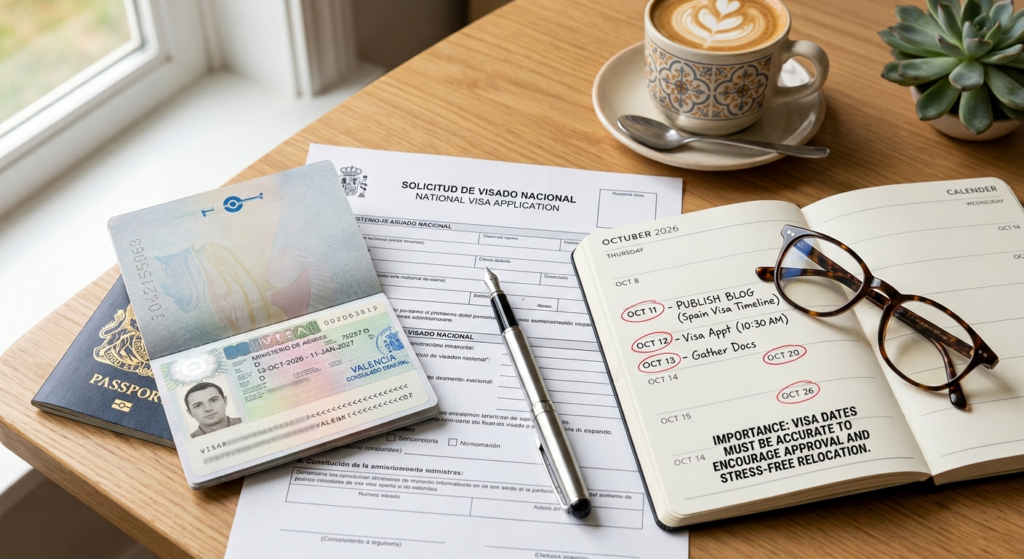
If there is one piece of advice we find ourselves repeating more than any other to clients planning a move to Spain from outside the EU, it is this: the timeline is not a detail you fit around the visa application, it is the thing that determines whether the application succeeds at all. Non-EU nationals, whether applying for the Non-Lucrative Visa, the Digital Nomad Visa, a work visa, or any other long-stay route, are working inside a sequence of interlocking deadlines, document validity windows and appointment availability that punishes poor planning far more severely than most people expect going in.
Why Timing Is Different for Non-EU Applicants
EU citizens relocating within the bloc benefit from freedom of movement and face none of this. Non-EU nationals do not have that luxury. Every long-stay Spanish visa route requires a formal application, typically submitted either at the Spanish consulate covering your place of legal residence or, for certain routes, through a dedicated Spanish immigration unit once you are already in the country. Each stage of that process has its own timing rules, and critically, several of your supporting documents have a limited shelf life before Spain considers them too old to rely on.
Get the sequencing wrong, and you do not simply experience a delay. You can find yourself needing to redo entire categories of paperwork, sometimes from scratch, because a document that was valid when you started gathering your file has expired by the time you actually submit it.
The Document Freshness Problem
This is the issue that catches more applicants out than almost anything else. Several of the documents required for a Spanish long-stay visa are only considered valid for a limited window, commonly three to six months depending on the document type and the specific consulate’s requirements:
- Criminal record / background check certificates (ACRO, FBI Identity History Summary, RCMP check, or the equivalent from your country of residence) are generally only accepted if issued within three to six months of your visa appointment or submission date.
- Medical certificates confirming you do not have a disease with public health implications are typically only valid for around 90 days.
- Proof of funds (bank statements, pension confirmations) usually needs to reflect a recent, ongoing picture of your finances, not a snapshot from many months earlier.
- Apostilles and sworn translations do not expire in the same way, but they take real time to obtain, and that time has to be planned around the expiry windows of the underlying document.
The practical consequence: if your background check takes eight weeks to arrive, your apostille takes another six to eight weeks, and your consulate appointment is still three months away, you may well find your background check has already gone stale by the time you actually sit down at the consulate, forcing you to restart that single piece of the process while everything else waits.
A Realistic Illustration: How the Pieces Actually Interlock
| Document gathering & background check request | 2–8 weeks, depending on country and method |
| Apostille processing | 2–10+ weeks, depending on issuing country |
| Certified Spanish translation | 1–2 weeks once source documents are finalised |
| Consulate appointment availability | 2 weeks to 3+ months, highly consulate-dependent |
| Consulate decision after submission | Several weeks to a few months, visa-dependent |
| Entry window after visa approval | Typically around 90 to 365 days to enter Spain, depending on the authorization type |
| TIE application after arrival in Spain | Usually required within 30 days of entry |
Notice how many of these stages can run in parallel rather than one after another, background check requests, apostilles and translations, for instance, do not all have to wait for each other to begin. The applicants who move fastest and most smoothly through this process are almost always the ones who map out which steps can run simultaneously and which absolutely must happen in sequence, rather than working through the list from top to bottom as it occurs to them.
Common Timeline Mistakes We See
- Booking a consulate appointment too early, before documents are ready, and then needing to request an expensive, hard-to-get rescheduling.
- Booking too late, discovering the next available appointment is months away, by which point other documents have already started to expire while waiting.
- Requesting a background check last, when it is often the single slowest item in the entire file, particularly for applicants needing an apostille from a federal or national authority rather than a faster local or provincial one.
- Assuming “processing time” quoted by an authority is the whole story, when in practice it is only one link in a much longer chain that also includes appointment availability, courier time, and your own document assembly.
- Not accounting for family members’ documents separately, each person on an application typically needs their own background check, medical certificate and supporting paperwork, each on its own clock.
Key Takeaway
A Spanish visa application is won or lost as much on sequencing as on substance. The requirements themselves are usually well understood by the time someone reaches out to us; it is almost always the timeline, which document to request first, what can run in parallel, how to work backwards from a target entry date, that trips people up. Planning this properly, ideally months before you intend to submit anything, is one of the most valuable and least glamorous parts of what we do for clients relocating to Murcia and Costa Blanca South.
If you are at the start of this process and want a realistic, personalised timeline mapped out for your specific visa route and nationality, that is exactly what our free 20-minute consultation is for. Let’s build your timeline properly, before the clock starts working against you.